· v0.10.0
Your companions can rob you in your sleep
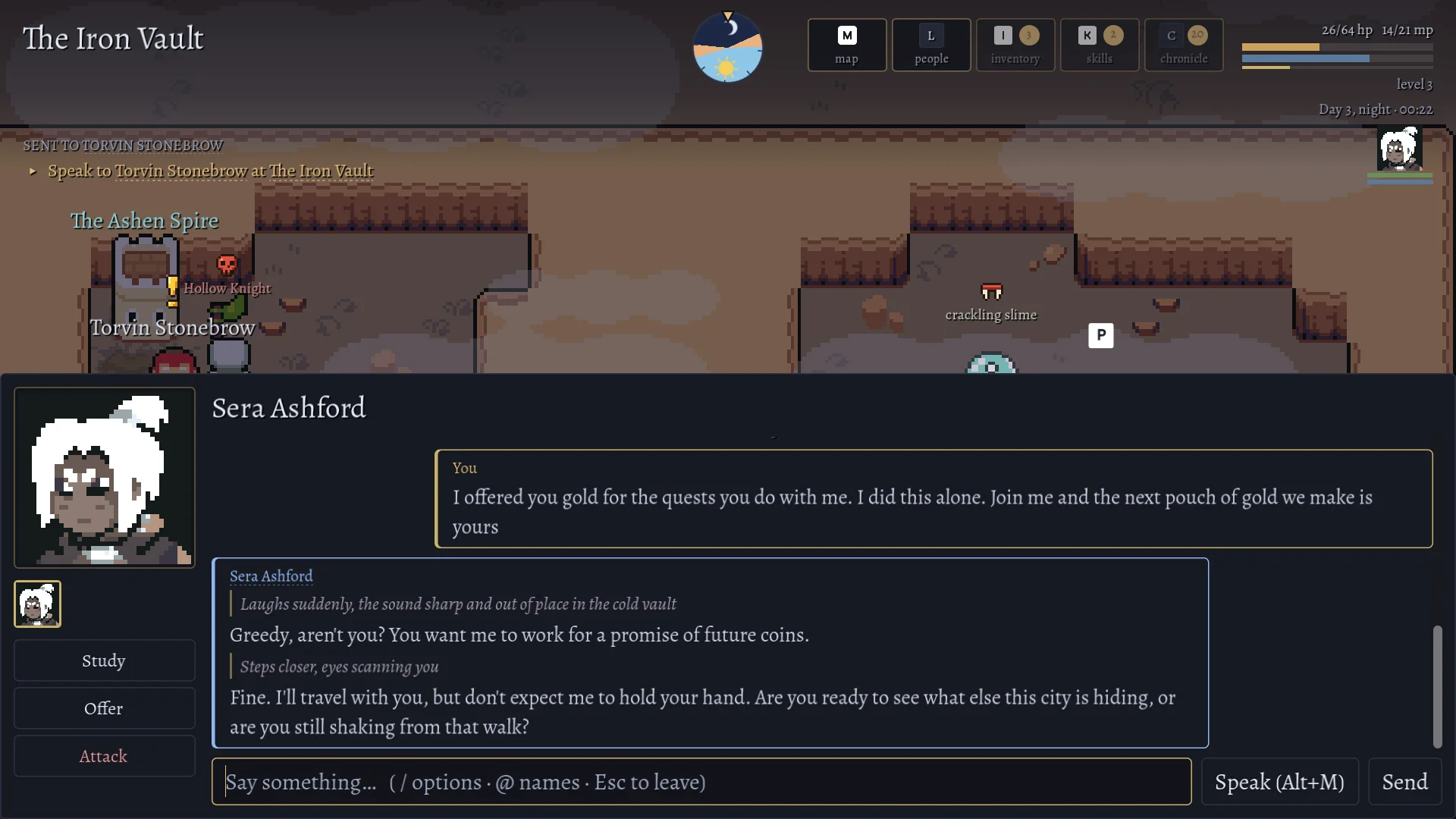
Resting at an inn, a rough camp or a roadside fire used to do two things: show a toast and jump the clock. Nothing could happen while you slept, because sleeping wasn’t a place in the game. It was a number being added to.
Meanwhile, companions had trust, and turning on the party was something that could only start in a conversation. The one moment a person would actually choose to turn on someone, when they’re asleep, did not exist.
A dial, then a night
The first piece was a day/night dial at the top centre of the HUD: a disc with the sun on one arc and the moon on the other, turning under a fixed pointer once a day, midday putting the sun under it. Conversation, travel and rest all move it.
The top centre turned out not to be free. The title column ran past the middle of a 1280-wide window, so it is now capped short of the dial, and on windows narrower than about 1080 pixels the dial steps down under the row of buttons.
The second piece reuses that dial. Every rest now plays a sleep overlay: the screen darkens, the dial grows to fill the middle and ticks from lying down to waking, with the hour under it and a line about the night, then the world fades back. A rest you can’t take, because you’re already rested, can’t pay, or have nothing to gain, is refused before any of that plays.
Who stays awake
On most nights, nothing happens and the night is calm. But a companion whose trust in you is low is now someone the night has to weigh. When there is one, the lines under the dial turn uneasy and the dial slows, and the night decides whether anyone acts and how.
They can rob you, and walk off with loose items and gold. They can wound you, and you wake hurt. Or they can turn on the party outright: you wake halfway through the night, unhealed, already in a fight with them, the rest of the party on your side.
A model writes what happened that night. It does not get the last word on what it costs. Its verdict is checked and clamped by code, so nothing it says can take more than the rules allow.
The betrayer runs
Someone who robs or wounds you doesn’t stay for breakfast. They become a fugitive: they go to ground somewhere else in the world, never where you are, and the People panel files them under Unknown, even in a town you’ve already discovered, so it can’t give their hiding place away.
Seeing them is finding them. Talking to one might not get you a conversation: they can bolt, and go to ground again. A fugitive in a fight can try to run too, and the warning shows before they act, so you always get a turn to stop them. Kill one and whatever of the party’s gear they were wearing comes back, whole.
Fights had treated fleeing as all or nothing. Any fleer on the party’s side ended the whole battle, so a companion with a flee move could end a fight by accident. Now one fighter can leave and the battle goes on without them. Only the player fleeing ends it.
Shadows follow the sun
The last piece of the week came from the dial. If the game knows where the sun is, the world should show it. Actors, props, trees and then buildings now cast a shadow that sweeps with the day: the sun rises at 06:00 and sets at 20:00, so shadows run long one way in the morning, short at noon, long the other way by evening, and the moon lays a faint one at night. Rooms, dungeons and the arena get none.