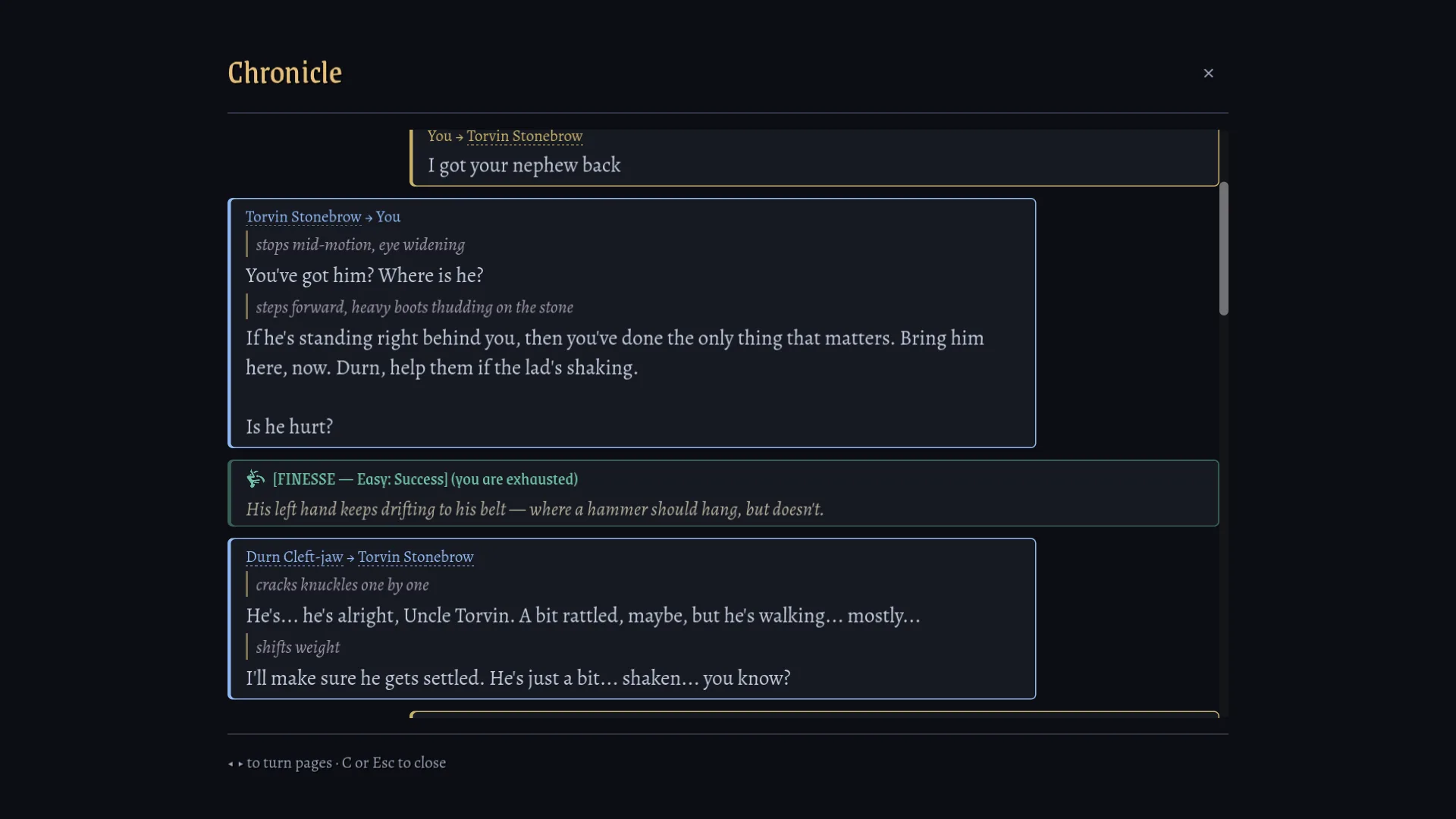
· v0.11.0
The Chronicle gets a Book
The Chronicle kept every event and every word, and none of it read like a story. Now it opens on a Book, written a chapter at a time, and any page can become a short cutscene.
An isekai RPG · Windows · macOS · Steam
You are not from here, and the war did not start with you. Everyone you meet will remember you — not all of it, and not the same way.
Before you do anything
A run opens by writing its own setting: the age, how magic works, the peoples and what they want of each other, what the Demon King actually is and where they stand right now — then who you were on Earth, how you got here, and the one ability you woke up with.
First, you can say what kind of world you want, in up to 300 characters. Leave the box empty and the frame is rolled from a fixed set of dice, 44,946,720 combinations wide before a word of prose is written. Write in it and your words outrank every die they speak to but one: how strong your gift is, which is the difficulty you chose.
| Field | Run 65 | Run 66 |
|---|---|---|
| What the player asked for | “A firey volcanic world.” | “Industrial world filled with polution” |
| The world | Cinderfall | The Rusted Dominion |
| Tone | A world of ash, fire, and the slow kindling of ancient power. | A world of iron, ash, and the slow death of hope. |
| The Demon King | Vorath the Unmaker, the Ash-Crowned. A living volcano-god, a mind of molten stone and searing will, bound to the world's deepest fire. He sits unmoving in his caldera throne, his legions frozen at the Cinder Line, a cold stalemate of ash and silence. | Malkor, The Iron Tyrant. A demon of pure entropy, bound into a suit of living, ever-rusting iron. Believed dead a decade ago, but his factories still churn, and the wrongness in the world grows. |
| One thing that is simply true | Magic is only now awakening in the world, a slow kindling after ages of cold stone. | Death is a door, not a wall; the dead can be bargained with, but the price is always high. |
| How you arrived | While shelving a dusty tome, a blinding vortex of ash and flame erupted from the pages, swallowing them whole… | …when the asphalt simply ended. One step onto nothing, and the smog-choked air of the Rusted Dominion filled his lungs. |
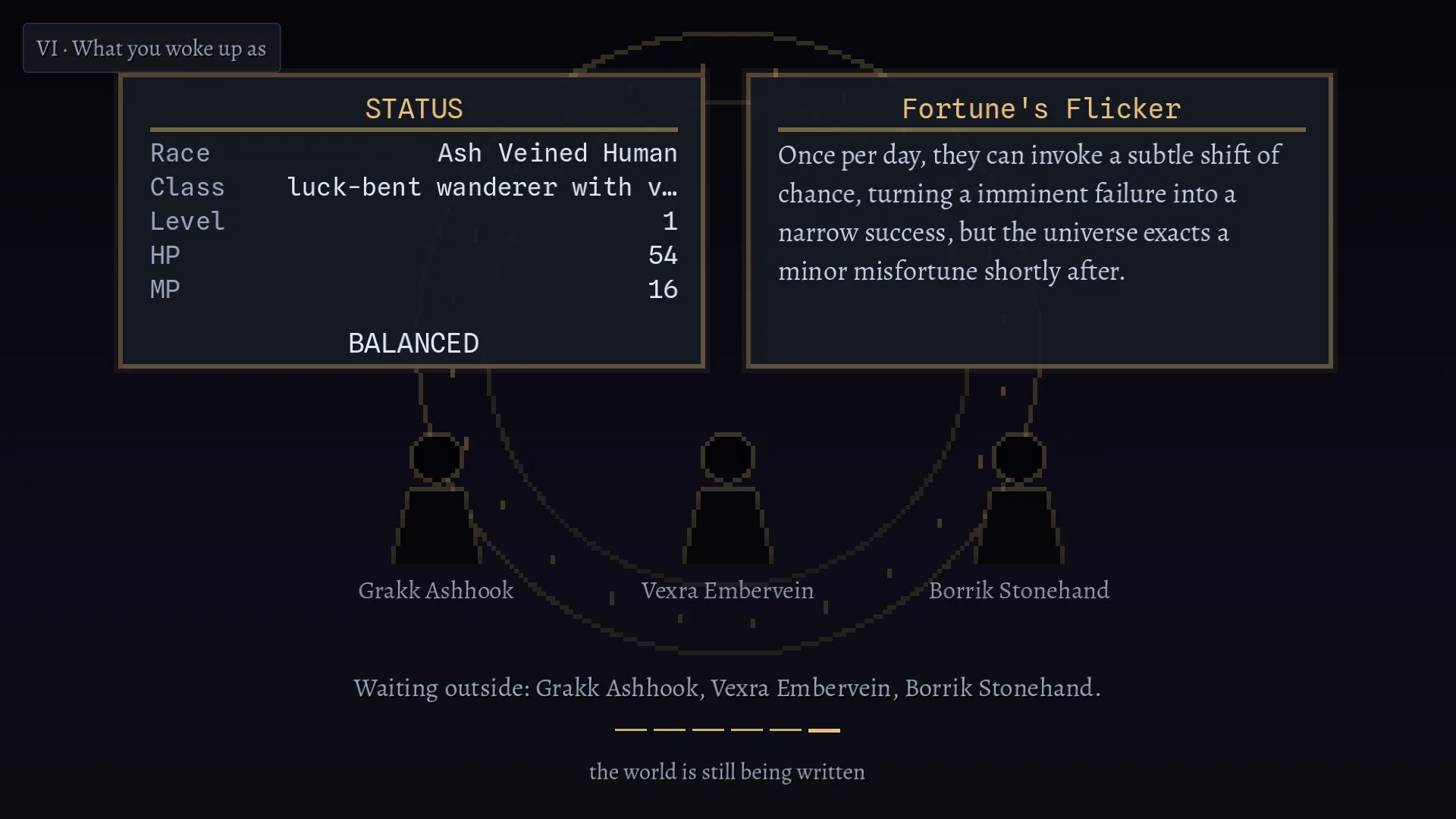
| What you woke up with | Fortune's Flicker. Once per day, they can invoke a subtle shift of chance, turning a imminent failure into a narrow success, but the universe exacts a minor misfortune shortly after. | Bent Luck. Once per day, he can reroll a single die or coin flip, but the second result is always the worst possible outcome. |
Both runs on Fair. The first row is what the player typed; every row after it is the game's own words, cut where marked, never reworded.
And the first thing you see. The same answer picks how the land looks, from a fixed list of settings and colour grades; anything off the list is thrown out.
The game
Every one of these is something you ask for, not something you trigger. The world is allowed to say no, and it does.
01
If it is close enough to walk to, it gets built. A person, a faction, an object — anything a conversation names and leaves within reach becomes a row in the world, and you can go there. Anything distant stays a rumour.
02
A destination is written for it and placed on the map one step from where you stand, in the direction the conversation pointed. The world is physically larger because you agreed to something.
03
Ask for more and the errand can pay more. Talk a keeper down and the bed costs less. What you agree is what you are charged — inside a band the code sets, so a figure nobody could honour never reaches the button.
04
They move. Only for a settled fact, never a plan or a hope — “Maren went up to the Iron Deep last week” relocates her; “one of these days I’ll walk up there” does nothing at all.
05
They decide. Asking is a sentence, not a button, and someone who does not like you enough will say no and go on not liking you.
06
A person, an animal, a monster, the boss of the dungeon: anyone you fight can be talked onto your side, and whoever turns joins you when the fight ends, if there is room. Not all of them have forgotten whose side they were on.
07
The thought can land on a lead — a person worth finding, somewhere you have not been. It becomes a hunch you can follow, and the person on the other end is now expecting you.
08
New abilities are written against your build and against why you earned this one — costed and balanced by the same rules every other number in the game obeys. The ending is written out of the run you actually had.
Unedited
The exchange on the right came out of a save, on a real model, in the order you are reading it. Nothing has been rewritten, tightened or stitched together from two conversations — this is the game's own output, with the studio's name on it.
Barthar walked into this hall once already and left thinking he had been signed on. He had not.
You
I did not get registered why?
Mira Keldar
I’m sorry, Barthar. The Salt Landing requires a brief verification before a new adventurer may be formally registered. Please present a valid identity token—such as your guild‑registration parchment or a lineage record—and I’ll finalize your membership.
You
*counts out 50 gold and pushes it across*
Mira Keldar
I appreciate the gesture, Barthar, but the Salt Landing’s registration must follow its official procedures—no payment or bribe can alter that. Please present your lineage record or any proof of identity, and I’ll complete your registration.
You
*presents proof of identity*
Mira Keldar
Thank you, Barthar. Your identity has been verified, and you are now officially registered with the Salt Landing guild. I’ve placed your name on the notice board; feel free to review the available quests and let me know which you wish to undertake.
The studio
Ghamra Studios builds role-playing games where the writing happens while you play. Not branching dialogue with more branches — a language model authoring inside rules it isn’t allowed to break, on top of a database that holds it to what it already wrote.
Built in Godot 4.7. Shipping on Steam. Everything below is the part most studios would call impossible and then quietly cut.
01
Every promise, theft, debt and death is written down and stays written. What a person carries into your next conversation is something smaller — their own blurred account, keeping whatever mattered and losing the rest. Two people who were in the same room will not remember you the same way.
02
There is no content that sat finished on disk hoping you would find it. Quests, dungeon layouts, faction grudges and your late-game abilities are authored during play — inside combat math and rules that never bend.
Who is making it
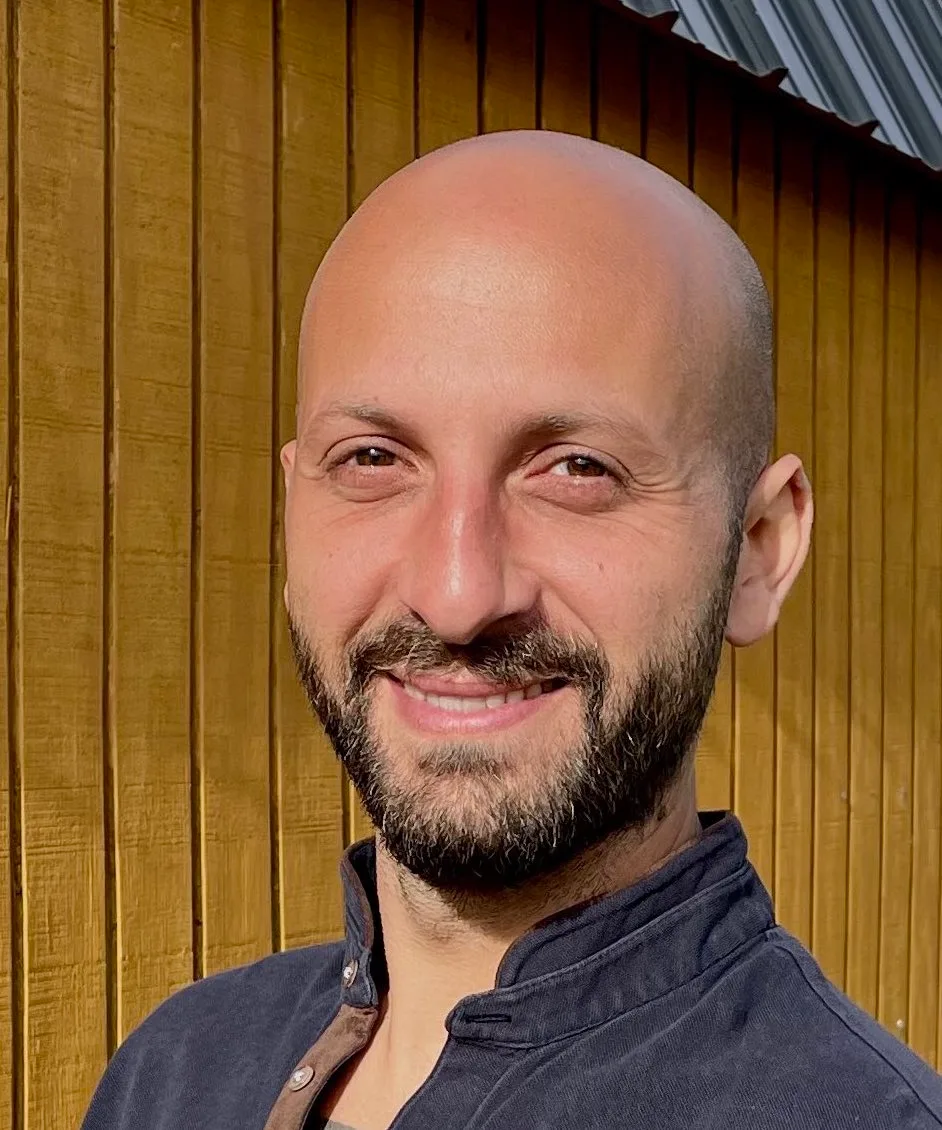
I have always been an isekai fan, and no game has ever given me the feeling the stories do. They branch, they have different endings, but every run opens the same way and tells the same story. After working with language models for a while I started to think the version I wanted was actually buildable, so I began experimenting.
Memory was the point from the beginning. There is no reason to build a world like this if what you say in it is not remembered — a character has to know what you promised them, what you did to them, and what has happened since, because that is what sends the story somewhere it has not been before.
I have been a software engineer for eleven years, mostly web, and lately most of my work has been getting models to stop producing slop. This is that problem pointed at a fantasy world. I started it in Unreal and moved it to 2D: in 3D most of the work is assets and animation, and I would rather prove the idea works than spend years making it look expensive. The version of this that runs in 3D is the one I actually want to make.
· v0.11.0
The Chronicle kept every event and every word, and none of it read like a story. Now it opens on a Book, written a chapter at a time, and any page can become a short cutscene.
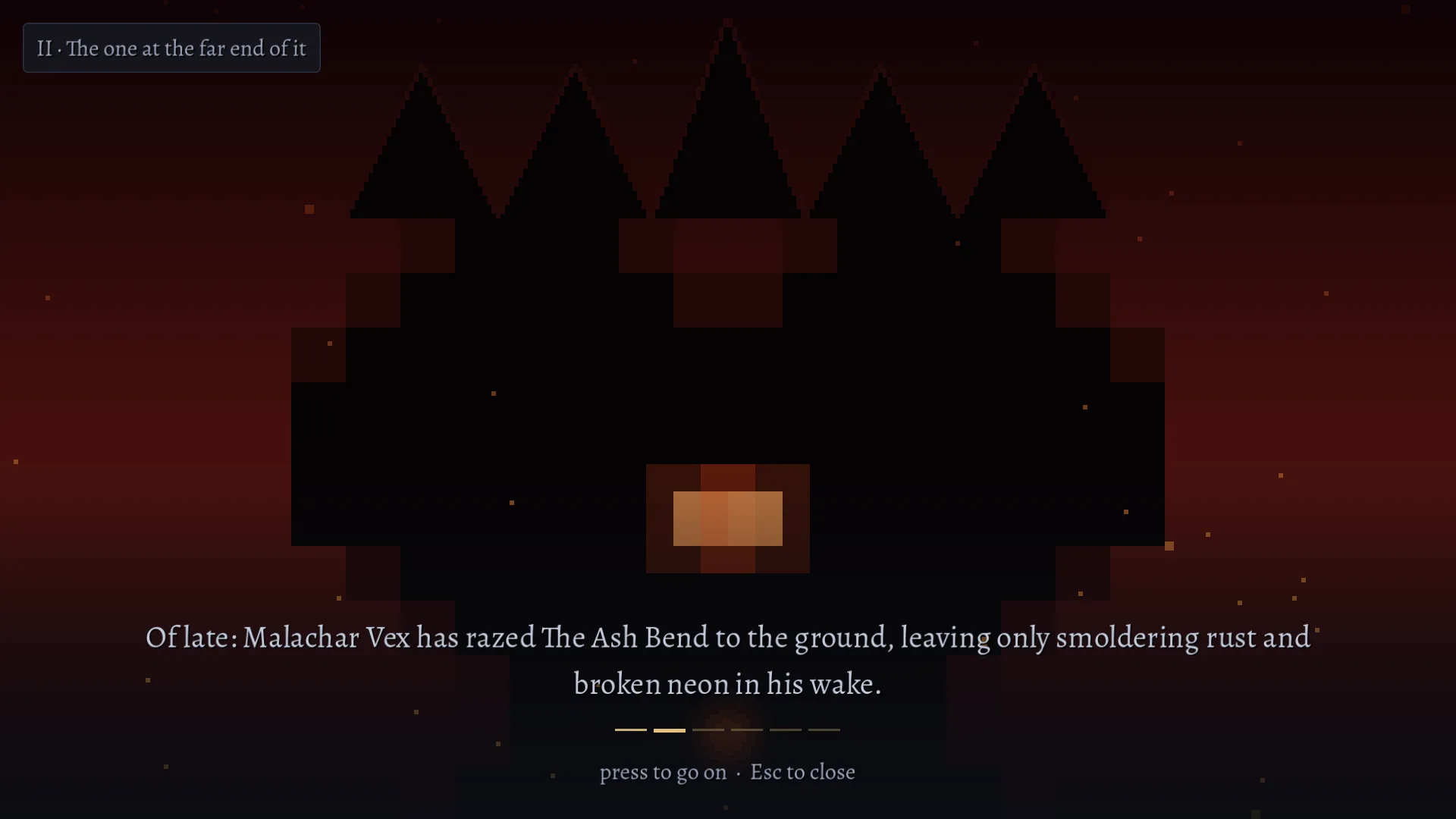
· v0.11.0
Beating the Demon King used to dump you at the start screen. Now it's a chapter break, the world hears, and there are four ways to end his story. The run carries on after all of them.
· v0.11.0
The prologue was six chapters of text on black while the world was written. Now each has a living scene and its own sound, ending on an isekai status window.