· v0.9.0
Everyone starts at the bottom
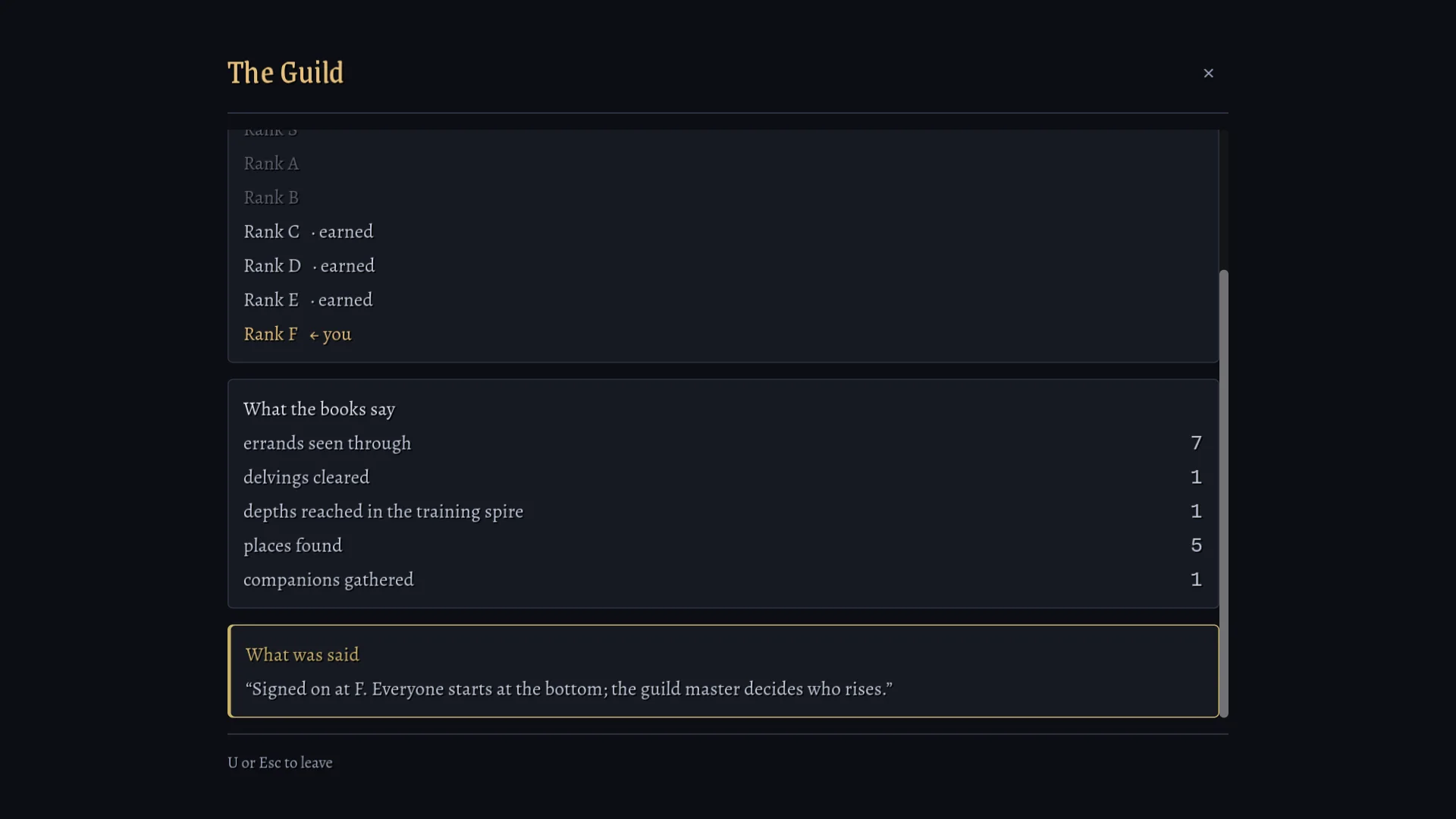
Once the guild halls had somebody in them, the next problem was getting onto the books, and then up them. The last pass undid the one before it.
The board
The hall gained a notice board on 11 September, standing beside the guild desk. Read it and you get three notices, each with a destination, a reward and a difficulty, alongside your current rank. Take one and it is the same errand a conversation would have given you, without the conversation. The price printed on the notice is the price you are paid.
A test that never became a quest
In one playtest the guild master, Soren Vale, told the player they would have to prove their worth first. No test ever reached the journal, and the player was signed on anyway.
On 13 September we made the master’s word binding. “Prove your worth first” became a real quest, the guild panel showed it as your test, and finishing it put you on the books.
Then we stopped asking
Five days later we took that decision away from the guild master altogether.
Joining had been the master’s verdict, written by a model at the end of a conversation. That made it a judgement, and a judgement can go wrong in every way a model call can. You might come away at F, or at E, or with a test to pass first, and with no model reachable you came away with nothing at all. Meanwhile a clerk behind the same counter might cheerfully have told you that you were in.
But nobody is turned away from rank F. Getting onto the bottom rung was never a judgement, and we had been treating it as one. So now asking the clerk is the whole of it: you are signed on at F, with no test, no minimum length of conversation, and no model asked, which means it works offline too. The note on your membership is written by the game, not by anyone’s model: “Signed on at F. Everyone starts at the bottom; the guild master decides who rises.”
The guild master keeps the part that really is a judgement. Their test is now a promotion test. It is only set when you have earned a rank above the one you hold, and finishing it raises you one rung.
The first cut signed you on the instant your line read as asking to join, before the clerk had answered. You joined mid-sentence. Now the clerk just talks, and closing the conversation is what writes the books. The rank toast and the guild panel wait for it.
A ladder set by climbing it
Earning a rank and holding one are different things now, and the cover shows it: C, D and E earned from deeds, and the player still at F until the guild master says otherwise.
The ladder those deeds are scored against had been marked provisional in the code itself, to be set by playing rather than guessed. Run 25 was the first real climb, and replayed against it the old ladder failed twice. S opened at minute 91 of a 119-minute run, so the top of the game went unplayed. And the middle collapsed: C, B and A all arrived inside three minutes, because one dungeon with its boss and its errands was worth more than the gap between two ranks.
The thresholds moved from 0, 4, 10, 20, 34, 52, 76 to 0, 6, 16, 36, 66, 110, 170. Replayed, that run now reaches E at about minute 10, D at 67, C at 76, B at 78 and A at 111, and never opens S, which is the intent. “A rank should not be one delve” is now a test, so the next retune has to argue with the fault instead of quietly recreating it.