· v0.9.0
Somewhere new is now a road you walk
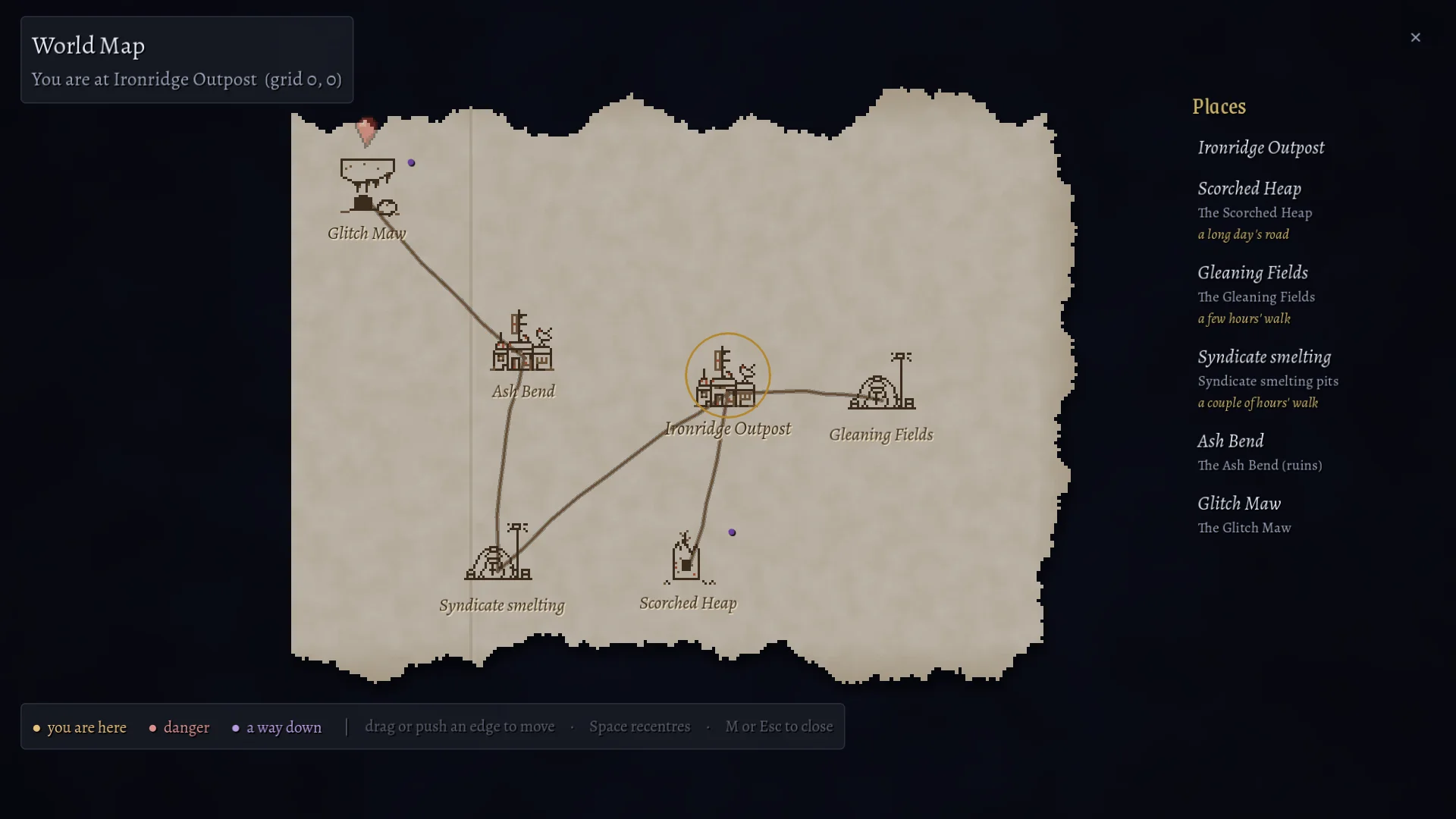
Picking a new place on the world map used to put you at its gate and leave you there. The place had to be written before you could go in, and until it was, you stood in front of a locked arch. It was a loading screen with scenery.
Now you walk there.
The walk is the wait
A place you have never been is always a road. A model writes the place while you are on it, and the road ends when the place is ready, but never before a minimum length scaled from how far apart the two places sit on the map: 16 tiles of road per grid step, never under 20 and never over 90. Under 20 it is a corridor, and a player who can see both ends at once has been shown a loading screen.
Somewhere you have been, and that is ready, is still instant. Somewhere you have been that is not ready yet is a road with no minimum, which ends the moment the place is.
Walking is capped at 300 seconds, not counting the pause menu. And before a road opens, the game asks whether the trip is allowed at all; without that, a road could walk you for five minutes toward somewhere travel would then refuse.
Built in code, on purpose
A road you only walk is dull, so the next three tickets put things on it. Each is deliberately not written by the model. The road exists to cover the time a place takes to make, and anything on it that also waited on the model would be competing with the very thing it covers for.
Monsters attack. A pack appears ahead, notices you and closes; an ambush stays hidden until you are nearer. The foes are read from creatures the run already has, or built in code. A test counts the model requests made from the moment a pack appears to the moment the fight opens, and expects none. Opening a conversation mid-fight is switched off on the road for the same reason. The suite was green when a windowed preview showed a live Talk button on a road fight anyway. That half was caught by looking, not by an assertion.
A trader. Some roads have a pedlar pulled over at the verge, where you can sell what the fights dropped and buy supplies before you arrive. The stall is stocked and priced in code, by the same rules as a town stall. A pedlar belongs to the road rather than to either town, so the same one is there on the way home. The first version put a pedlar on the way out and nobody on the way back; the suite caught it.
People walking the other way. Travellers tagged “walking the other way” stood on one tile, on their idle frame, for the whole journey. A playtest note said it plainly: people walking by should actually be walking. They now move at 120 pixels a second, half the player’s 240, which is slow enough that a pass is readable.
One line, 526 pixels wide
A line spoken over somebody’s head on the road was meant to wrap at 220 pixels. It drew one row 526 wide, ran under the notification column and was cut off mid-word. Every line of that code was correct. The order was the bug.
In Godot, a Control’s size is clamped to its minimum size at the moment it is
assigned, and never shrunk afterwards. A Label with autowrap off reports a
minimum as wide as its whole sentence. We set the size two lines before turning
autowrap on, so the label was pinned at full width and “wrapped” at 526. Autowrap
now goes first. A test pins it, and was seen to fail against the old order
first: expected 220, got 526.