· v0.11.0
The Chronicle gets a Book
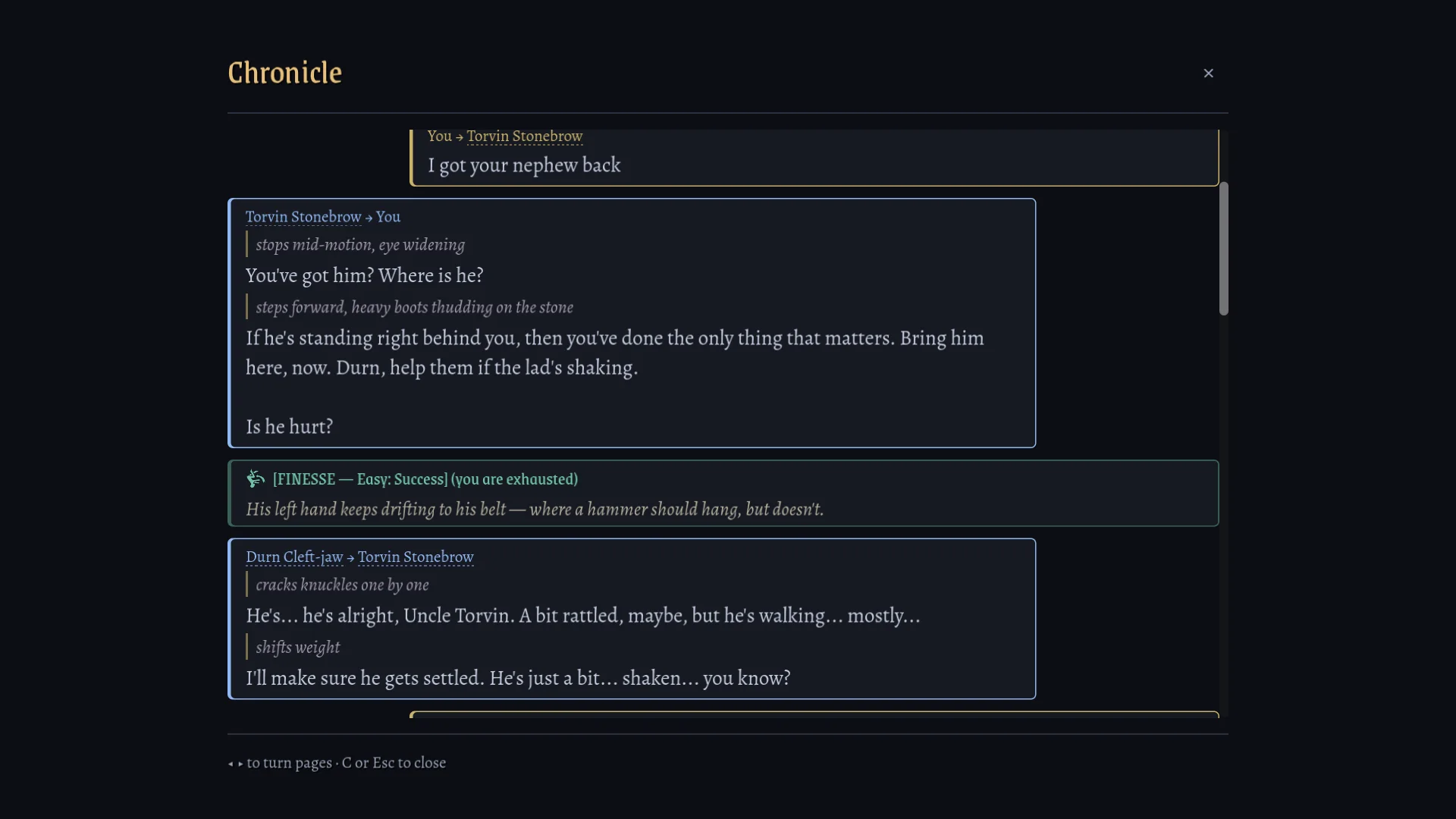
The Chronicle has always been complete: what happened, what you were shown, what was said, what people thought. What it never did was read like a story. A record of a long run is something you search, not something you sit down with.
On 30 September it gained a new first tab, and it now opens there: The Book.
Chapters come due
The Book has a prologue, numbered chapters, and an epilogue once the run reaches an ending. A chapter comes due when the run turns: a new act of the story begins, a storyline reaches its last beat, you beat a kind of boss for the first time, you finish a storyline quest, or the Demon King falls. Moments that land close together merge into one chapter rather than stacking up. No model decides when a chapter is owed.
A model writes the chapters in the middle, and not at the moment they come due. It waits for a safe point: not paused, not mid-fight, not while another card is on screen. Until then the contents list the chapter as “being written…” and it cannot be opened. What comes back is checked before it reaches the page.
Early live runs found two faults. One chapter ended on the previous chapter’s closing sentence, word for word. Another recited every level and coin the run had recorded, down to “Thirteen gold and a Healing Salve”. Both were fixed before the day was out.
Reading it
The reader shows one page at a time, turned with the arrow keys or the shoulder buttons, and opens on the newest chapter you haven’t read. Each page has its in-game day and place, a plate drawn in-engine, and a quote that is the line as it was actually said, taken from the conversation rather than rewritten. The page’s footer opens What happened and What was said, narrowed to that chapter’s stretch of the run, so the story always leads back to the record.
Pictures, if you ask
Any page of the Book can be turned into a short cutscene, and only if you ask. You can wait for it, or keep playing and be told when it is ready. It never plays by itself. It can be skipped, and the first play shows a photosensitivity note. If a request is refused, Try again tells the scene more gently, and a second refusal takes the button away for that chapter.
Those pictures are made in an art style the player chooses on the new-game page, from a list of presets or in their own words, or left to the run to pick. It is fixed for the run. It styles the Book’s cutscenes, illustrations and cast portraits and nothing else: the world you walk through is the same sprites it always was.
That field is a reversal from the same day. The first version had a model write each run’s style. Live play showed it drifting from picture to picture, one cutscene near-photoreal and the next painterly, and cutscenes that did little more than animate a portrait. By the end of the day the written style was gone, and the style became something the player can read and change.
Names stay out of every request for a picture: yours, and everyone else’s in the chapter. People are described, never named. A picture doesn’t need your name. In testing a first name slipped through anyway, so now the parts of a name are taken out as well as the whole.
It travels with the run
A run exported as a .sew file now carries its pictures and films, and older
files still import. Import treats the file as hostile: names and sizes are
judged before anything is read, contents must match their type, and any
failure rolls the whole import back. Deleting a run deletes its media with it.