· v0.11.0
The first two minutes
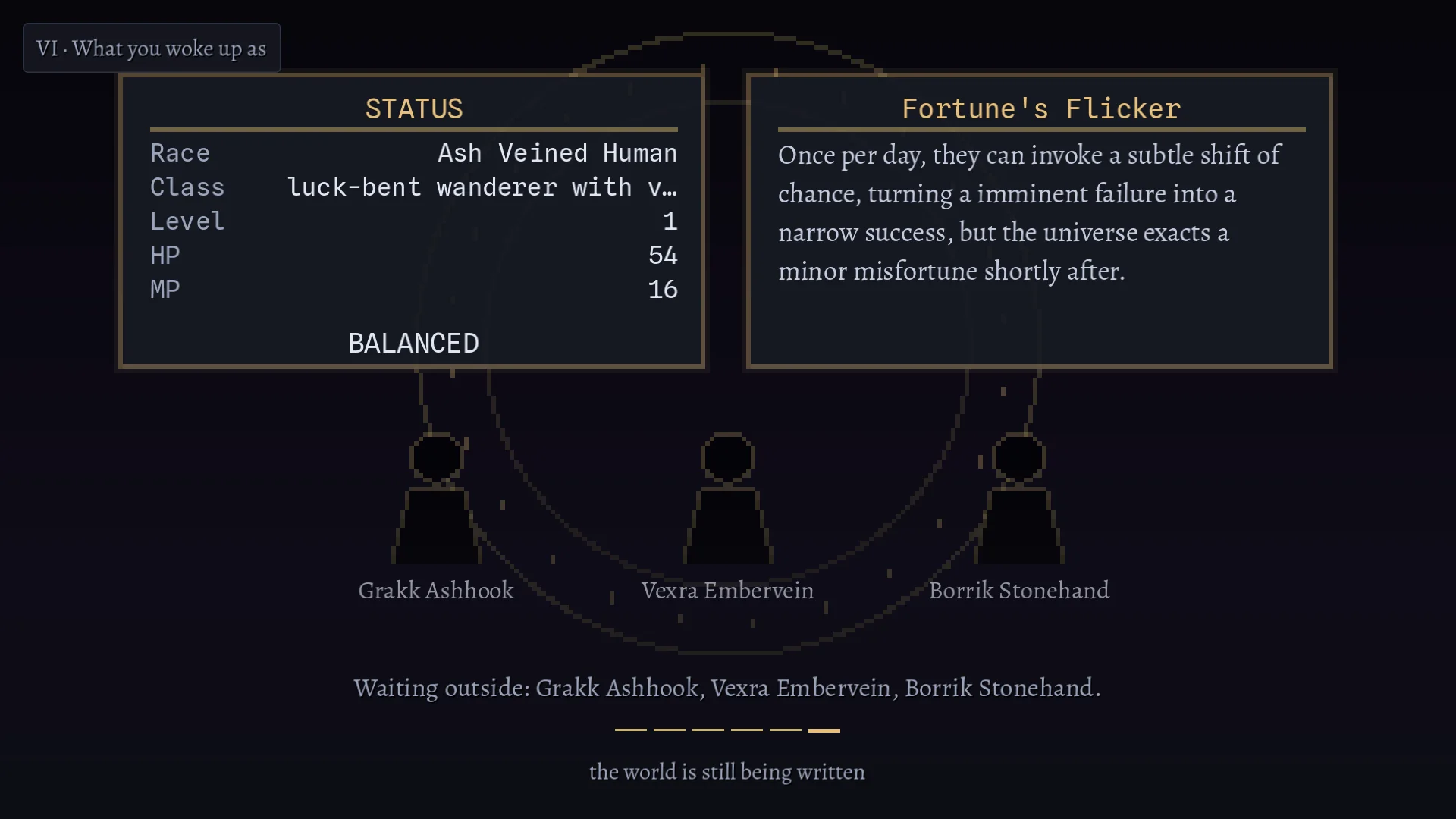
The first thing a new run does is make the player wait while the world is written. Since 31 August that wait has been a prologue in six chapters: the world you have fallen into, the one at the far end of it, who you were, how you arrived, where you fell, and what you woke up as. Each chapter holds until the next is ready, so on a slow machine the prologue simply stretches.
It was six screens of text on black.
A voice per run
The text came first. Until 18 September the prologue had no voice of its own, and it read like a modern pitch. Now each run rolls one: archaic, or a grave, high-epic prose. It is also darker, though never explicit. Archaic is kept for the adult reading level. The teen setting on New Game promises no archaic phrasing, so it gets high-epic, and so does the simplest level. If the player’s wish names a style, the wish wins.
A scene behind every chapter
On 29 September each chapter got a living scene behind its text, with the prose in a band at the foot.
- I. The world’s landscape in layers panning at their own speeds, with its own weather blowing across: sand, snow, rain, ash, pollen.
- II. The Demon King as a huge crowned silhouette against a dark red sky. His eyes light just before his name finishes landing. On a slow model this is the chapter most often held, so the embers rising past him are what the player watches.
- III. Their room on Earth at three in the morning: rain on the window, a flickering screen, a ticking clock.
- IV. That room tears, the screen whites out in one smooth ramp rather than a strobe, and the new land comes back out of the white.
- V. The run’s real map on dim parchment, under fog except around the start. Drag to clear it. It shows only what the map itself would name, so it spoils nothing, and places appear on it as they are written.
- VI. The status window.
What you woke up as
Chapter VI is the screen above. Race and class type in, and level, HP and MP count up from zero to the character’s real numbers before their starting strength stamps in. Then a card flips in with the signature gift, and on the last line the people “Waiting outside” fade in as silhouettes with their names beneath. Names only, so nothing is spoiled before you meet them.
The numbers are the sheet’s own, the same on the first run and on a replay from the chronicle.
Sound
Each scene now has an ambience: fire under the Demon King, wind where you fell, a low drone under the status window, rain in the Earth room, and rain or wind in chapter I depending on the world’s weather. Three stingers mark the big moments: a low hit as the King’s eyes light, the rift at the crossing, and a chime as the window opens. All of it comes from the game’s existing CC0 pack and sits on the effects slider.
What we got wrong
The scenes are drawn at a quarter of screen resolution and scaled up, and at first so were their words. An 8px pixel font blown up four times rendered “Human” as “Hurnan”. The next day every readable word moved to screen resolution, the prologue text grew by half, and the status window turned crisp.
The same fix caught a stranger one: the mouse reached through the prologue to the start screen underneath, so the Tutorial button’s tooltip floated over the opening.
And the count-up always ran, because the game had no reduced-motion setting. A single switch for reducing motion and flashing arrived the day after. With it on, the numbers are simply there.